The canyon run
The standard day: transfer upstream, full gear, licensed skipper, lunch at the camp afterwards with most operators.
ON REQUESTSET BY THE OPERATORUp to around 1,300 metres deep, with its final stretch running along the Bosnia–Montenegro border. This page is the practical version — when to come, which section, what is provided and what is not. We do not sell seats; we point you at the right operator.
The Tara Canyon is up to around 1,300 metres deep and about 80 kilometres long. The Montenegrin part lies within the Durmitor area, which is inscribed on the UNESCO World Heritage List. The final stretch, the one most people raft, runs along the border and finishes in Bosnia at Scepan Polje.
FOCAFLYSPIN does not run rafting trips. We have no boats and no camp. What we do is match you to a licensed operator that fits your group, your date and the water level that day — then you deal with them directly, at their price. Nothing is added on top for you.
Seventeen points in order downstream — the rapids you paddle and the places where the boat stops. Tap any of them.
Upper and lower. This is where the run begins — and the longest single rapid on the whole river. Also the moment you find out the water is eight degrees.
A short quiet stretch after the first hit. The river settles just long enough for you to catch your breath and look up at the walls.
You pass under a sheer cliff pocked with caves. One of the most photographed points on the run.
More than half a kilometre of continuous water. Named after the pines it runs through.
Named after the timber-rafters’ postman, from the days when logs were floated down the Tara. People left messages here.
Two rapids with no pause between them. This is where you find out whether the crew learned the commands.
Deep pools full of trout. Anglers in the boat tend to stop paddling and stare into the water here.
Upper and lower. The biggest drop on the section and the largest waves. If there is one moment everybody remembers, this is it.
They come after a flat stretch. By now you know what you are doing and run them without thinking.
Water drops around twenty metres straight into the Tara from the right wall. Skippers bring the boat close enough that the crew almost passes underneath. The name comes from spring, when the springs run wild — that is when they are at their best.
A waterfall fed by a cave lake, falling over moss-covered rock. A separate stop from Manita vrela, further down.
Remains of an artificial dam built during Austro-Hungarian rule to move timber. The only trace of human hands on this part of the river.
A curving rapid in the narrows just past the dam. This is where the skipper asks for a faster stroke.
A rapid below an old mill, then two named rocks. Each carries a story from when people still lived in the canyon.
A small river entering from the right in a series of little waterfalls with natural pools beneath them. The standard stop — a short walk, a swim and photographs. The water is cold enough to numb your hand in seconds.
The final rapids before Scepan Polje. Cegrlo also goes by Vucje grlo, wolf’s throat.
Scepan Polje, where the Tara and the Piva meet and become the Drina. Locally it is called Sastavci, the confluence. You climb out of the boat here.
The exact programme and price depend on the operator, group size and time of year. Send an inquiry with your date and numbers and you will get concrete offers back — we do not set the prices and we do not add anything on top.
The standard day: transfer upstream, full gear, licensed skipper, lunch at the camp afterwards with most operators.
ON REQUESTSET BY THE OPERATORThe season runs from April to mid-October, but every month is a different river. Spring means high, cold, fast water and a shorter, harder run. By midsummer the river has settled and warmed, and the day on the water gets longer because the boat stops more. Same kilometres, completely different trip.
Season opens. Snowmelt water, cold and powerful. The fastest run of the year — sometimes under three hours. A wetsuit is not optional. Better for people who want the intensity than for a first family trip.
Similar to April but with longer days and warmer air on the bank. The rapids are at full strength and the photographs are at their most dramatic, with water breaking over everything.
The level starts dropping but the river is still serious. A good middle ground — quick enough to be exciting, forgiving enough for a first run. The water is still cold.
The most requested month. Warmer water, strong sun, and a longer day on the river because the boat stops more often for swimming. Camps fill up — book earlier than you would for other months.
The warmest water of the year and the longest run, up to four and a half hours with stops. The best month for families and for anyone getting into a raft for the first time.
The crowds thin out, the water is still pleasant and the canyon turns. A gentler run than spring but the river is far from asleep. A lot of people call this the best month.
Operations wind down around mid-month. Cold on and off the water, but the canyon is empty and quiet. Check availability before planning — not everyone still runs.
Nothing runs from November to March. Levels are unpredictable, the water is freezing and most camps are shut. If you want Foca in winter, it is the mountains and the national park instead.
Families are common on the Tara, but the rules are not the same at every operator or in every month. This is what is worth knowing before you send an inquiry.
Age. The minimum depends on the operator, the section, the water level and the time of year. In spring, with the river high, the limit tends to be higher than in summer.
Swimming. Not required on every programme, but the rules depend on the operator. A life jacket gives buoyancy; it does not remove the risk in the water.
When to come. July and August: warm water, a longer run, more stops for swimming. April and May suit older, more experienced paddlers.
The Tara is navigable for around a hundred kilometres, but almost all rafting happens on the last part of the canyon, where the rapids are densest. These are the three programmes normally on offer.
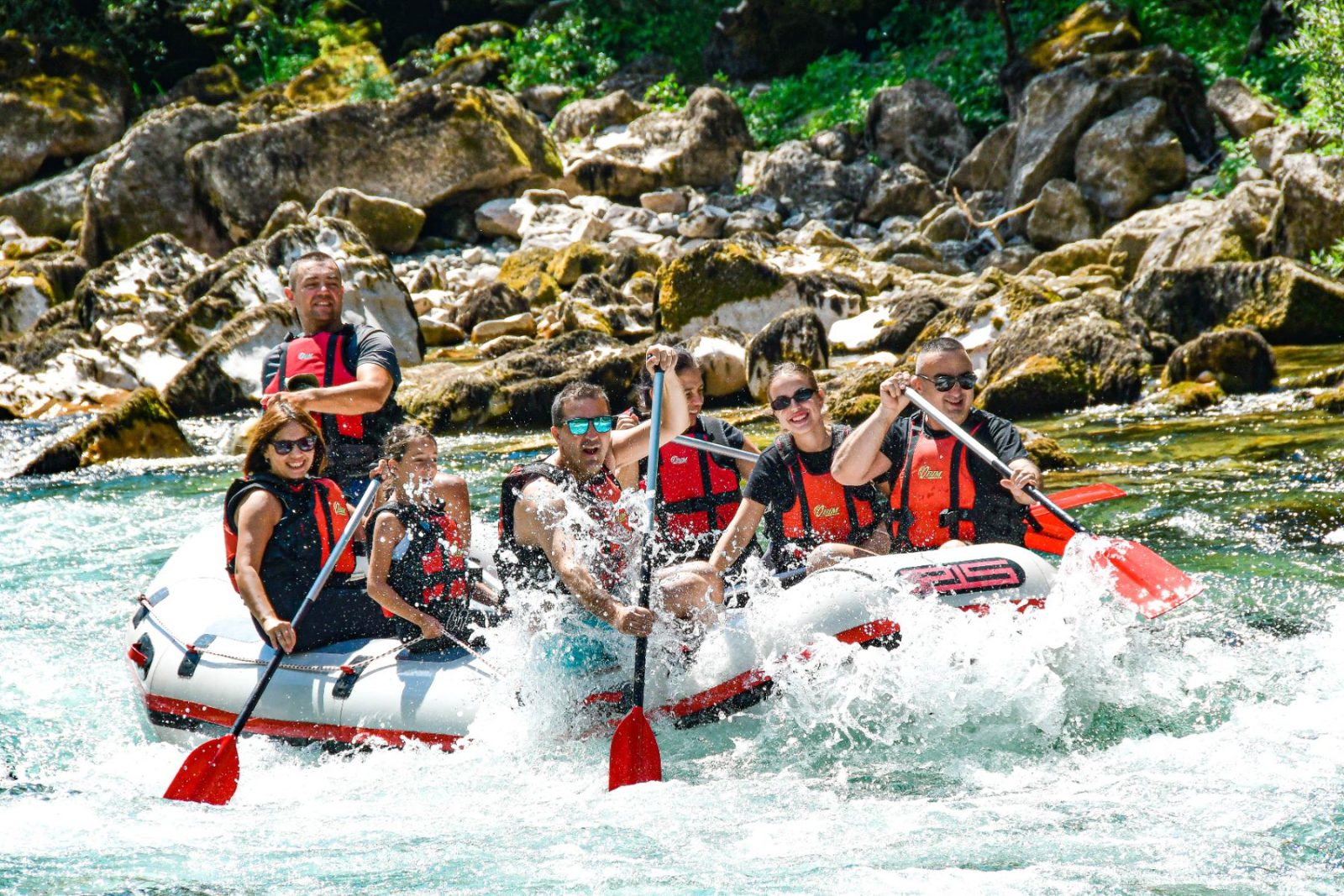
The classic day run and what most people mean by rafting the Tara. The densest stretch of rapids on the river — around twenty of them in eighteen kilometres.
The continuation down the Drina, considerably gentler than the Tara. Rarely run on its own — usually added to the main day, or offered as the easier option for groups with small children or older guests.
An expedition from the upper river down to the confluence, sleeping on the water. Passes Bajlovica sige, the Tepca rapids and the suspension bridge. Needs more planning and agreement in advance.
Rafting on the Tara is a run with licensed skippers, but it remains a whitewater sport. Nothing removes the risk entirely — there are procedures that reduce it and people who know them.
You get a briefing before you start. Short, on the bank: how to hold the paddle, what the commands mean, where your feet go under the straps, what happens if someone goes over the side. Do not talk through it — that is the only information you get before you are on the water.
The buoyancy aid stays on. Not just in the rapids, not off when it gets hot. It provides flotation and helps keep you at the surface, though it does not remove the risk of moving water. Whether swimming ability is required depends on the operator and the programme — ask when you book.
Going over the side is not an emergency. It happens, it is planned for, and the skipper knows the procedure. The rule is feet downstream, on your back at the surface, do not try to stand up. The skipper or a neighbouring boat brings you in.
No alcohol before the run. Operators can refuse anyone who has been drinking, and they use that right.
Whether the trip runs that day, on which section, and who gets in the boat is decided by the operator based on the water level and the makeup of the group. That decision is not negotiable.
Foca is in south-eastern Bosnia and Herzegovina, where the Cehotina joins the Drina. The rafting camps are upstream, towards Scepan Polje and Bastasi. Most operators run the transfer from the camp to the put-in — getting to the camp is on you.
No. You get gear and a short briefing from the skipper before you go in — the commands, and what to do if someone ends up in the water. There is a licensed skipper in every boat.
It is the international scale of whitewater difficulty, running from I to VI. This stretch of the Tara sits around three to four depending on the water level, rising higher in spring. Serious, but run daily by first-timers with a licensed skipper.
Swimwear, shoes that can get wet and dry clothes for afterwards. The water gear — wetsuit, buoyancy aid, helmet — comes from the operator.
It depends on the operator, the length of the programme, the date, the number of people and what is included. We do not set prices. Send us your dates and group size and we will come back with actual offers rather than a guess.
Between two and a half and four and a half hours on the Brstanovica – Scepan Polje section. Shorter in April and May because the water moves faster, longer in July and August because the boat stops more often.
It depends on the operator, the section, the water level and the time of year. Family programmes can have different rules from the standard run, and in high water the age limits go up. Send us the ages of the children with your inquiry and we will find something that genuinely fits.
Buoyancy aids are mandatory for everyone. Whether swimming ability is required varies between operators and programmes — tell us who is coming and we will check the rules that apply to your date.
It happens and there is a procedure for it. Feet downstream, stay on your back at the surface, do not try to stand. The skipper or a neighbouring boat picks you up. You are briefed on this before the run.
Bring your passport or national ID. The Tara forms the border with Montenegro along this stretch and operators ask for documents even when no crossing is involved.
Depends what you want. April and May give the fastest, hardest run in cold water. July and August are warmest and best for families or a first raft. September is the compromise — fewer people, comfortable water, autumn colour in the canyon.
Yes, and most people do. Rafting pairs easily with Sutjeska National Park, the walk up to Trnovacko Lake, or a day fishing the Drina with us. Say what interests you in the inquiry and we will lay out the days.
The run goes ahead — you are getting wet anyway. It is only cancelled if the water level goes past what is safe, and that call is made by the operator on the day.
With some operators, yes — a calmer section combined with something else on the same day or stay, such as the sand pyramids at Miljevina. Send an inquiry with the makeup of your group and we will tell you what is available.
People who raft the Tara usually end up doing something else while they are here — fishing the Drina, walking up to Trnovacko Lake, or a day in Sutjeska National Park. Tell us how long you have and we will put the days together.